

Okun Unity Dialogue: ODI Pushes Leadership Charter to Unite Okun Leaders Across Party Lines
The Okun Development Initiative (ODI) has called for a renewed commitment to political unity and collective action among Okun leaders and elites, saying internal divisions have weakened the region’s ability to effectively negotiate and attract meaningful development at the state and federal levels.
The Founder and President of the initiative, Deacon Otitoju Olusuyi, stated this in outlining the focus of the forthcoming Okun Unity Dialogue 2026, a gathering designed to provide a platform for frank discussions, mutual understanding and a renewed commitment to the development of Okunland.
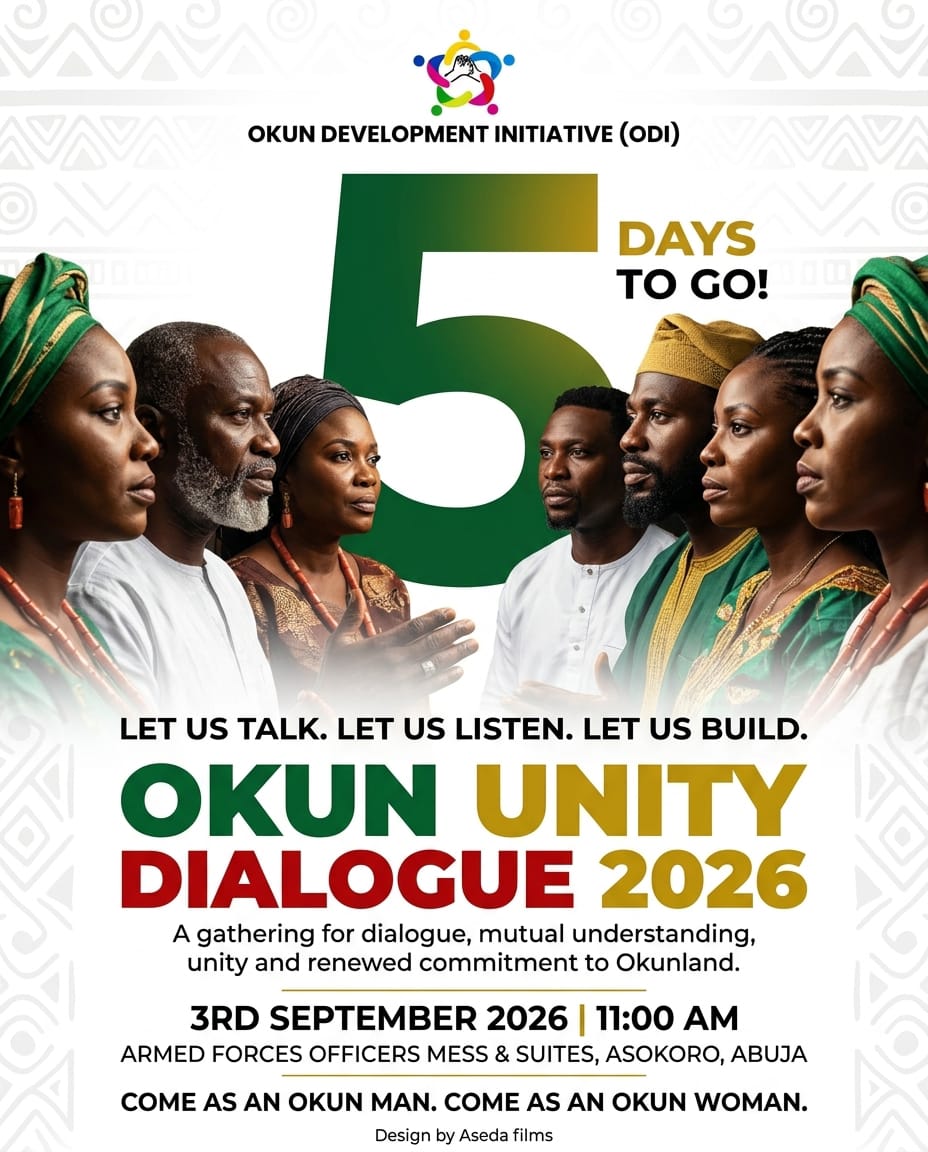
The dialogue, scheduled for September 3, 2026, at 11:00 a.m. at the Armed Forces Officers Mess & Suites, Asokoro, Abuja, is expected to bring together Okun leaders, professionals, political actors, community stakeholders and other influential voices to deliberate on issues affecting the region.
According to Olusuyi, the programme is built around the theme “Unity for Strength: Building Strategic Elite Consensus and Political Cohesion,” with particular attention to the political acrimony that has, over time, created divisions among Okun leaders and diminished the region’s collective bargaining strength.
He explained that the initiative is not intended to promote any political party, individual or personal interest, but to encourage stakeholders to identify areas of common interest and develop a shared position on issues that directly affect the future of Okunland.
A major objective of the dialogue is the development of a non-partisan “Okun Leadership Charter of Unity”, which is expected to provide a framework through which leaders can commit themselves to speaking with a common voice on critical matters, including political zoning, state creation, appointments and regional development.
The initiative believes that such a framework could help reduce unnecessary rivalry among Okun leaders and provide a stronger platform for pursuing issues of collective importance.
Olusuyi stressed that the central question before Okun leaders is how to place the interest of Okunland above political party affiliation, personal ambition, ego and individual interests.
The organisers maintain that political differences should not prevent leaders from cooperating on issues that affect the general wellbeing and future prospects of the people.
The dialogue is therefore expected to create an avenue for participants to openly examine the factors responsible for political fragmentation within Okunland and consider practical ways of building consensus without demanding uniformity of political opinion.
The initiative argues that unity does not necessarily mean that every Okun stakeholder must belong to the same political party or hold identical political views. Rather, it seeks a situation where differences can coexist while leaders remain united on matters of fundamental regional interest.
The programme’s emphasis on elite consensus is also aimed at strengthening the capacity of Okun leaders to engage governments and institutions at both state and federal levels on development priorities.
The organisers believe that a more coordinated approach could improve the region’s ability to advocate for infrastructure, political representation, appointments, economic opportunities and other development priorities.
With the theme of the programme centred on dialogue, listening and building, participants are expected to use the gathering to identify areas of disagreement, seek common ground and develop a more constructive approach to regional leadership.
The Okun Unity Dialogue 2026 comes at a time when questions of political representation, regional development and collective bargaining continue to generate discussions among stakeholders across Okunland.
Olusuyi said the initiative is inviting Okun men and women to participate in the process, stressing the need for broad-based ownership of any framework that emerges from the dialogue.
The programme carries the message: “Let us talk. Let us listen. Let us build.”
For ODI, the objective is to move the conversation beyond expressions of concern to the development of a practical and enduring commitment among leaders to work together for the advancement of Okunland.
The initiative maintains that a divided Okun will struggle to attract the level of attention and development it deserves, while a united leadership with a clear and common agenda would be better positioned to engage decision-makers and pursue the collective interests of the people.
The Okun Unity Dialogue 2026 is consequently being positioned as an opportunity for Okun stakeholders to begin a fresh conversation on political cohesion, shared leadership and the responsibilities of the elite in shaping the region’s future.