
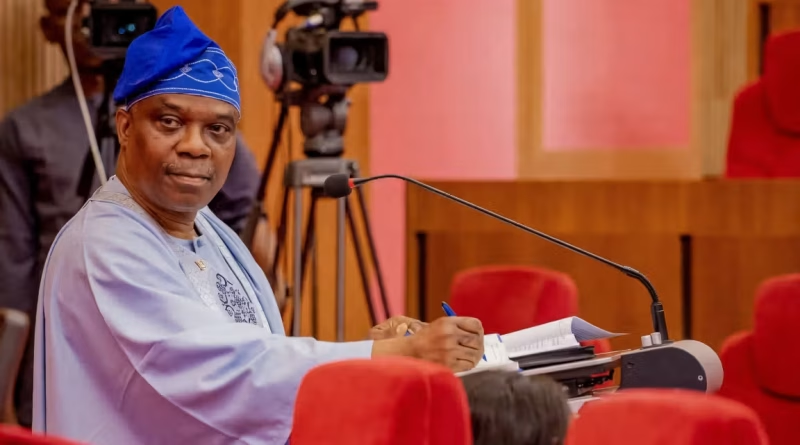
Repositioning Nigeria’s Foreign Policy: How Ambassador Sola Enikanolaiye Is Redefining Diplomacy for National Interest
By J.O. Abel-Ontop
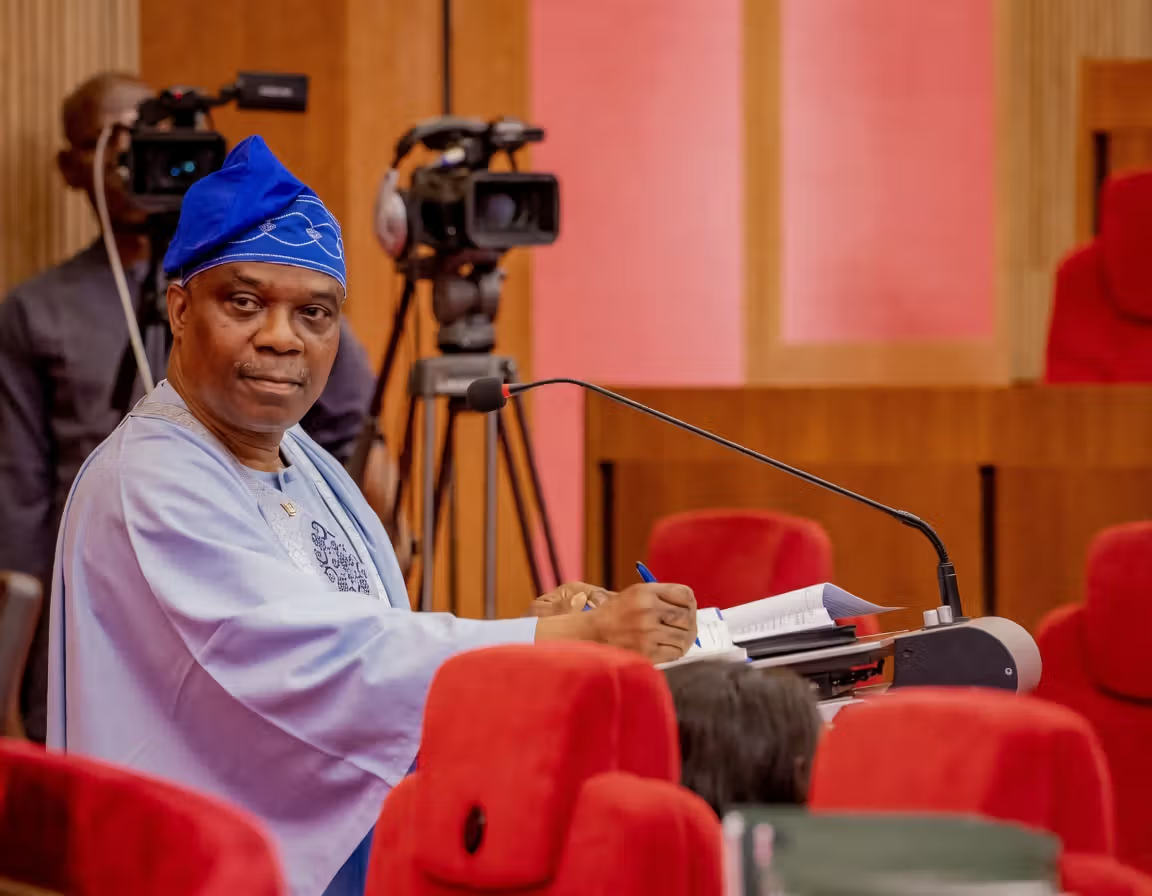
For more than six decades, Nigeria’s foreign policy has been largely defined by its Afrocentric orientation, placing the country’s diplomatic influence at the service of African unity, peacekeeping, decolonisation and regional stability. While that doctrine earned Nigeria enormous respect across the continent, critics have often argued that the country’s foreign engagements did not always translate into tangible benefits for ordinary Nigerians.
Today, a quiet but significant shift is underway.
Under the leadership of the Minister of State for Foreign Affairs, Ambassador Audu-Rafiu Olusola Enikanolaiye, Nigeria is gradually embracing a foreign policy that seeks to balance its historic continental responsibilities with a stronger commitment to national interest, economic prosperity and citizen welfare.
The emerging doctrine—popularly described as “Nigeria First”—is not a rejection of Africa. Rather, it represents an evolution of Nigeria’s diplomatic philosophy, placing Nigerians and Nigeria’s development at the centre of every international engagement.
A Diplomat Prepared for the Moment
Ambassador Enikanolaiye’s ability to drive this policy shift is rooted in decades of diplomatic experience.
A distinguished career diplomat, he joined Nigeria’s Ministry of Foreign Affairs in 1982 and rose through virtually every level of the diplomatic service before becoming Permanent Secretary of the Ministry. He later served as Director at the National Defence College, where he contributed to strategic security studies, before serving as Senior Special Assistant to President Bola Ahmed Tinubu on Foreign Affairs ahead of his appointment as Minister of State for Foreign Affairs in June 2026. Throughout his career, he has served in several foreign missions and has earned a reputation for intellectual depth, institutional memory and strategic diplomacy.
Those who have worked closely with him often describe him as a quiet reformer—one who believes diplomacy must produce measurable value for the nation rather than remain merely ceremonial.
That philosophy is increasingly becoming evident in Nigeria’s foreign policy direction.
From Afrocentrism to “Nigeria First”
Perhaps the most defining feature of Ambassador Enikanolaiye’s diplomatic vision is the recalibration of Nigeria’s traditional Afrocentric foreign policy.
Rather than abandoning Africa, the Minister has argued that Nigeria must first build internal strength before projecting influence abroad.
According to him, “We are locating Nigeria and Nigerians at the core of foreign policy preoccupations so that our national interest that advances our security, our defence and our economic prosperity are the core of Nigerian foreign policy.”
His argument is both practical and strategic.
A nation battling insecurity, economic challenges and social divisions, he believes, cannot effectively play the role of continental leader without first consolidating stability at home.
As he has repeatedly maintained, “You cannot have a dynamic and activist foreign policy if the home is weak.”
The policy therefore seeks to ensure that every diplomatic engagement contributes directly to Nigeria’s security, investment opportunities, trade expansion, technological partnerships and employment generation.
The 4D Framework
Complementing the “Nigeria First” doctrine is the administration’s 4D Foreign Policy Framework built around:
- Demography
- Development
- Democracy
- Diaspora
Unlike previous diplomatic frameworks that focused primarily on interstate relations, the 4D model places people at the centre of diplomacy.
Speaking during the 2026 National Diaspora Day celebration, Ambassador Enikanolaiye described Nigeria’s population and global diaspora as strategic national assets capable of driving economic transformation rather than burdens to be managed.
With more than US$21 billion remitted annually by Nigerians abroad, the Minister believes the diaspora should no longer be viewed merely as a source of remittances but as partners in investment, innovation, technology transfer and national development.
His emphasis on “talent circulation” instead of “brain drain” reflects a modern understanding of global migration, where skilled Nigerians abroad can contribute significantly to national growth without necessarily returning home permanently.
Diplomacy With Measurable Outcomes
Another notable feature of Ambassador Enikanolaiye’s approach is the growing emphasis on economic diplomacy.
Rather than measuring diplomatic success solely through bilateral agreements or international conferences, the new orientation seeks practical outcomes—foreign direct investment, expanded export markets, technology partnerships, educational exchanges and improved opportunities for Nigerian businesses.
This aligns with President Bola Tinubu’s Renewed Hope Agenda, where diplomacy is increasingly expected to support domestic economic reforms and national development priorities.
In essence, embassies are expected to become facilitators of investment, trade and innovation, not merely centres for protocol and consular services.
Institutional Reform
Beyond policy formulation, Ambassador Enikanolaiye has also shown commitment to strengthening Nigeria’s diplomatic institutions.
Shortly after assuming office, he engaged retired Nigerian ambassadors and senior diplomats, stressing that their institutional knowledge remains invaluable to ongoing reforms within the Ministry of Foreign Affairs.
The initiative underscores his belief that effective diplomacy requires continuity, mentorship and preservation of institutional memory rather than constant reinvention.
Beyond Diplomacy
Ambassador Enikanolaiye’s greatest contribution may ultimately lie not in introducing an entirely new foreign policy but in redefining the purpose of diplomacy itself.
His approach reflects a broader understanding that international relations should serve the everyday aspirations of citizens—creating jobs, attracting investment, expanding educational opportunities, protecting Nigerians abroad and enhancing national security.
It is a philosophy that aligns diplomatic engagement with measurable national development outcomes.
For a country seeking to reposition itself within an increasingly competitive global order, such an approach may prove both timely and necessary.
If successfully sustained, Ambassador Enikanolaiye’s “Nigeria First” doctrine could mark one of the most consequential shifts in Nigerian diplomacy since independence—preserving Nigeria’s leadership role in Africa while ensuring that the dividends of diplomacy are felt first by Nigerians themselves.